

215 Harry Howard Avenue • Hudson, NY 12534 • 518.828.4360 | Maria Suttmeier, Superintendent
Home
Dignity for All Students Act (DASA) What is Bullying? Facts About Bullying Parent Resources Student Resources Books on Bullying Contact the School
Home | Facts | What is Bullying | Parent Resources | Student Resources |
Books | Contact Us | Dignity For All Students Act
What is Bullying?*
Bullying is a conscious, willful, deliberate, hostile and repeated behavior by one or more people, which is intended to harm others. Below are the four major types of bullying, and examples.
Types of Bullying*
- Verbal Bullying: involves name-calling, antagonizing, gossip, teasing, put-downs, verbal taunts, threats and intimidation.
- Physical Bullying: involves hitting, kicking, punching or touching with an intended purpose to hurt/harm another person. Examples: physical violence and attacks, extortion or stealing of money and possessions.
- Cyber Bullying: involves the use of information and communication technologies to support deliberate, repeated and hostile behavior by an individual group, that is intended to harm others.
- Emotional Bullying: this can be the most hurtful type of bullying. This is usually done in a group, and with a purpose of humiliation. Examples: exclusion from the peer group, intimidation, put-downs and name-calling.
Who is Bullied?*
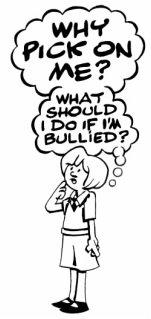
- Studies show that between 15-25% of U.S. students are bullied with some frequency ("sometimes or more often") while 15-20% report that they bully others with some frequency.
- Boys are more likely than girls to bully others. Girls frequently report being bullied by both boys and girls, but boys are most often bullied only by other boys.
Children Who Bully*
Many children engage in bullying everyday. Although each child is different, those who bully other young people do share some common characteristics. Here are some things to look for:
- Impulsive, hot-headed, dominant
- Easily frustrated
- Lack empathy
- Have difficulty following rules
- View violence in a positive way
- Boys who bully tend to be physically stronger than other children.
Why is Bullying Sometimes Hard to Detect?*
Unfortunately, although bullying can be very harmful to children, adults are often unaware of bullying problems. Why? Often, bullying takes place in areas of schools, homes, or communities that are not well supervised by adults. Even if bullying happens near adults, sometimes we miss it because bullying can be subtle or hard to detect (e.g., social exclusion, note-passing, threatening looks).
Adults also are often unaware of bullying because many children and youth don't report it. They may fear retaliation by children doing the bullying. They also may fear that adults won't take their concerns seriously or will act inappropriately to deal with the bullying.
Adults also are often unaware of bullying because many children and youth don't report it. They may fear retaliation by children doing the bullying. They also may fear that adults won't take their concerns seriously or will act inappropriately to deal with the bullying.
What Are the Consequences of Bullying?*
Children and youth who are bullied are more likely than other children to be depressed, lonely, anxious; have low self-esteem, feel unwell, and think about suicide.
How Aware of Bullying are Adults?*
Adults are often unaware of bullying problems. In one study, 70% of teachers believed they intervene "almost always" in bullying situations; only 25% of students agreed with this assessment.
What Can You Do to Help?
- Learn to recognize the warning signs that your child is involved in bullying (he/she could be being bullied, bullying others, or witnessing bullying). Oftentimes children being bullied are afraid to speak up because they do not want to “tattle.” Know the signs and talk to your child often!
- Talk with, and listen, to your kids every day. Make sure they know they can come to you if bullying, or cyberbullying, occurs.
- Do not blame the victim, but offer support. Avoid critical phrases such as, “What did you do to bring it on or start it?” or “You need to start standing up for yourself.”
- Be a good example and positive role model by demonstrating appropriate behavior toward others. Create healthy anti-bullying habits early.
- Teach your child to respect others and take a stand against all kinds of bullying, including bullying that takes place via technology (cyberbullying).
- Educate your child and yourself about cyberbullying, which includes email, social media websites and text messages. Be aware of what your child is doing online and with cell phones. Keep a record of cyberbullying incidents, if possible.
- Teach your child how to be a good witness, as well as when and how he/she should report bullying incidents.
- If your child experiences or witnesses bullying, contact the teacher, counselor or principal as soon as possible. You can call the school directly or contact the building DASA Coordinator.
- Stay involved!
For more information about what parents/guardians can do to prevent and respond to bullying, visit www.stopbullying.gov/what-you-can-do/parents
*Information provided by: www.stopbullyingnow.org
If you have difficulty accessing certain content on this website, please email District Communications
